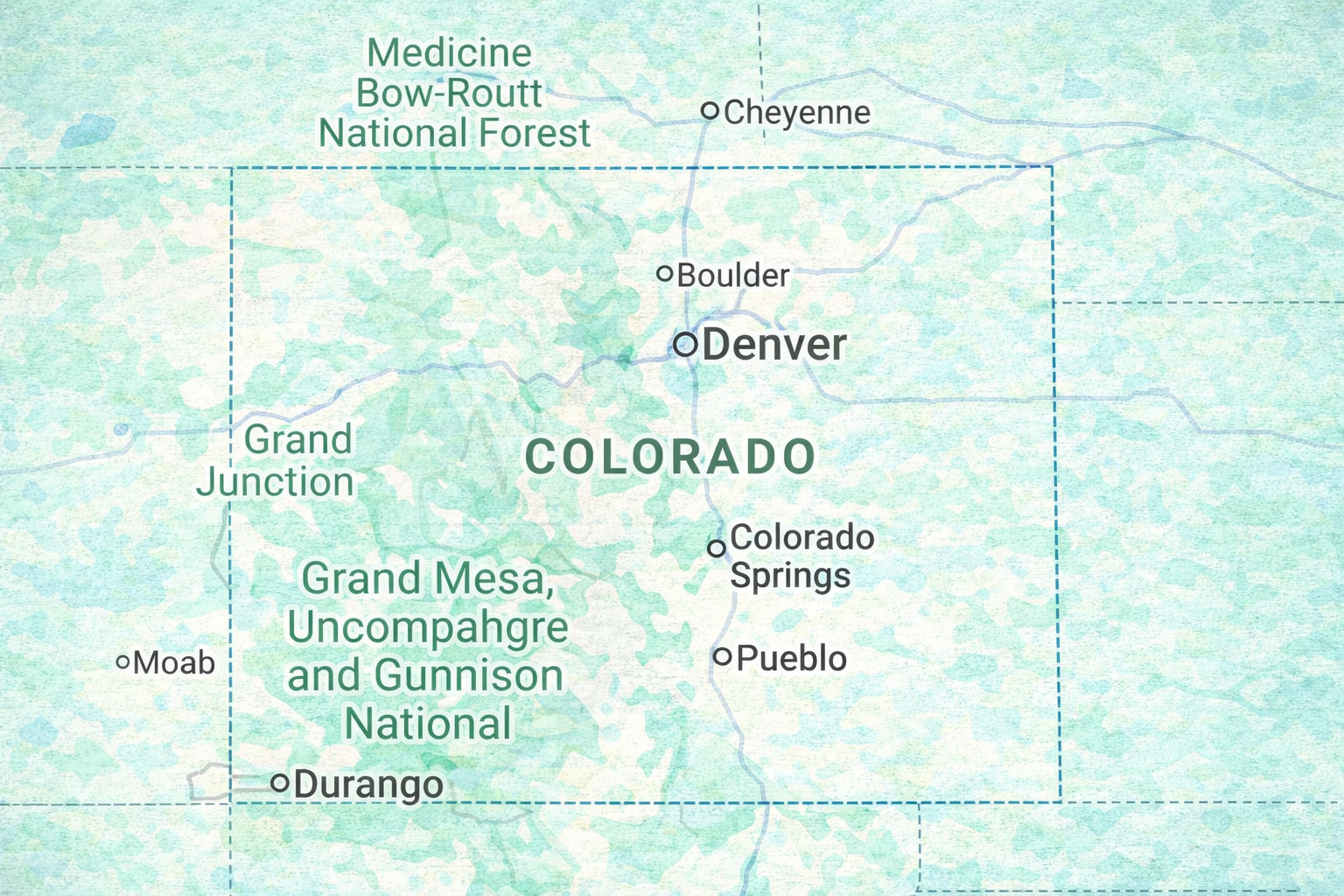
The Ultimate Guide to Insurance Appraisal in Colorado
How property insurance appraisal works in Colorado — governed by policy language, regulated by DORA Bulletin B-5.26, and subject to the state's statutory framework for claims handling and bad faith remedies.
Written by
Sarah PatchCo-Founder and Insurance Appraisal Writer
20 years across construction, design, and insurance-related work, including experience serving as an appraiser.
Colorado insurance appraisal quick reference — key facts under a policy-based appraisal framework with regulatory guidance from DORA Bulletin B-5.26
Legal Authority for Insurance Appraisal in Colorado
Colorado does not have a standalone appraisal statute. Unlike some states that have enacted appraisal statutes, Colorado's appraisal process comes entirely from the policy language itself — the standard appraisal clause included in virtually all property insurance contracts sold in the state.
The standard ISO homeowners policy appraisal clause provides that if the insured and insurer disagree on the amount of loss, either party may demand an appraisal. Each party selects a "competent and impartial" appraiser within 20 days. The two appraisers then select an umpire. If they cannot agree on an umpire, either party may ask a court to appoint one. Each appraiser separately determines the amount of loss. If the appraisers agree, the amount of loss is binding. If they disagree, they submit their differences to the umpire, and an agreement by any two of the three is binding.
"If you and we fail to agree on the amount of loss, either may demand an appraisal of the loss. In this event, each party will choose a competent and impartial appraiser within 20 days after receiving a written request from the other. The two appraisers will choose an umpire. If they cannot agree upon an umpire within 15 days, you or we may request that the choice be made by a judge of a court of record in the state where the 'residence premises' is located. The appraisers will separately set the amount of loss. If the appraisers submit a written report of an agreement to us, the amount agreed upon will be the amount of loss. If they fail to agree, they will submit their differences to the umpire. A decision agreed to by any two will set the amount of loss."
In plain terms
When the insurer and the policyholder cannot agree on the value or amount of a covered loss, either side can trigger appraisal with a written demand. Each side selects their own appraiser. Those two appraisers choose a neutral umpire. If any two of the three agree on a number, that figure becomes the binding award. Because Colorado's framework is policy-based rather than statutory, the specific terms can vary between insurers — the policy at issue controls, not the standard ISO language.
DORA Bulletin B-5.26
The Colorado Division of Insurance, a division of the Department of Regulatory Agencies (DORA), issued Bulletin No. B-5.26, titled "Requirements Related to Disputed Claims Subject to Appraisal." The bulletin was originally issued in 2011 and later reissued, including a substantial revision in October 2015. It sets out the Division's position on appraisal-related conduct in disputed property claims, including standards for appraisers and umpires, disclosure obligations, communication rules, and prompt-payment expectations once an agreed value is reached.
Bulletin B-5.26 requires:
1. Disclosure. Appraisers and umpires must disclose to all parties any financial or personal interest in the outcome, and any current or previous relationship with the parties, their counsel, witnesses, or other panel members.
2. Continuing obligation. The disclosure duty continues after appointment — any newly discovered facts that could affect impartiality must be disclosed.
3. No ex parte communications with the umpire. During the appraisal process, the umpire may not communicate privately with either side, their representatives, or the appraisers; any communication with the umpire must include both parties or their representatives.
4. Clean claim compliance. After the panel reaches an agreed value, the insurer must comply with Colorado Regulation 5-1-14's clean claim standards for prompt payment.
Bulletin B-5.26 is not a statute or regulation; it reflects the Division's interpretation of existing insurance law. The Colorado legislature considered codifying appraisal-related standards through HB 18-1153 in 2018, but the bill failed in the House Finance Committee. As a result, the bulletin informs the Division's enforcement posture but has not been enacted into statute, and its authority is narrower than a statutory mandate.
Bad Faith Protections
Colorado's prompt-payment statutes, enacted in 2008 through HB 08-1407, prohibit insurers from unreasonably delaying or denying payment of benefits owed to a first-party claimant. The statutory remedy includes two times the covered benefit, plus reasonable attorney fees and court costs. Because that statutory amount is separate from the covered benefit itself, total exposure is often described as potentially reaching three times the benefit amount, plus fees and costs.
For appraisal practitioners, one recurring question is whether completion of the appraisal process forecloses statutory delay or bad-faith claims. The Colorado Court of Appeals addressed that issue in Andres Trucking Co. v. United Fire & Casualty Co., 2018 COA 144. The court held that, although the appraisal award was binding as to the amount of loss, it did not preclude the insured from pursuing breach-of-contract or statutory unreasonable delay/denial claims based on the insurer's conduct before, during, or after the appraisal process.
Unfair Claims Settlement Practices
Colorado's Unfair Claims Settlement Practices Act identifies claim-handling conduct that insurers are prohibited from using, such as misrepresenting policy terms, failing to respond promptly, failing to investigate reasonably, and offering substantially less than the amount ultimately recovered. The Act does not itself create a standalone private right of action; enforcement is generally reserved to the Commissioner. Even so, those standards remain relevant in private litigation because Colorado law allows such conduct to be considered in determining whether an insurer unreasonably delayed or denied benefits. In appraisal matters, that means the valuation process may resolve the amount of loss, while claim-handling conduct can still remain at issue.
State Regulator
Colorado Division of Insurance (DOI)
The Colorado Division of Insurance operates within the Department of Regulatory Agencies (DORA). The Commissioner is appointed by the governor and confirmed by the state Senate. The Division does not license or register property insurance appraisers. Colorado has no state licensing requirement for property insurance appraisers or umpires. Qualifications are governed by the policy language (typically "competent and impartial") and the impartiality standards in DORA Bulletin B-5.26.
Property insurance appraisers are distinct from real estate appraisers, who are licensed by the Colorado Board of Real Estate Appraisers under a separate regulatory framework.
Colorado Division of Insurance
Commissioner: Michael Conway
Denver, CO 80202
Residual Market
Colorado FAIR Plan
Colorado established its FAIR (Fair Access to Insurance Requirements) Plan through HB 23-1288, signed into law on May 12, 2023. The Plan began accepting residential applications on April 10, 2025, with commercial applications following in mid-2025.
The Colorado FAIR Plan was created to address tightening insurance availability in areas with elevated wildfire and hail exposure. It functions as an insurer of last resort — applicants must demonstrate three declinations from standard market carriers before qualifying.
Coverage limits: $750,000 for residential property (dwelling and contents combined). The statute authorizes up to $5,000,000 for commercial property. Policies are actual cash value only — not replacement cost. Base coverage is limited to losses from fire and lightning. Optional endorsements are available for windstorm or hail, explosion, riot or civil commotion, vehicles, smoke, volcanic eruption, and vandalism. The Plan does not include water damage, building code upgrade, additional living expenses, or personal liability coverage.
The Colorado FAIR Plan's appraisal procedures are governed by its plan of operation, approved by the Division of Insurance on July 26, 2024. The residential policy is written on a modified ISO Dwelling Property Basic Form (CFP DP 00 01 01 25). Practitioners handling FAIR Plan claims should review the specific policy form for appraisal provisions, as they may differ from standard ISO homeowners language. Given the Plan's ACV-only coverage structure, the appraisal panel's scope and valuation methodology will necessarily differ from replacement-cost disputes under standard market policies.
Key Distinction
Appraisal vs. Arbitration in Colorado
Colorado has adopted the Revised Uniform Arbitration Act. DORA Bulletin B-5.26 explicitly borrows the UAA's impartiality standard for appraisers and umpires — but appraisal and arbitration remain legally distinct proceedings.
The Colorado Supreme Court in City & County of Denver v. District Court, 939 P.2d 1353 (Colo. 1997), recognized that Colorado supports alternative dispute resolution mechanisms when agreed to by the parties. Federal courts applying Colorado law have cited that principle when enforcing insurance appraisal clauses, and some have stated that doubts about the scope of an appraisal clause should be resolved in favor of appraisal.
Is appraisal binding in Colorado?
Yes — per the policy language, an agreement by any two of the three panel members sets the amount of loss and is binding on both parties. Colorado courts treat appraisal awards similarly to arbitration awards, giving them a presumption of correctness. Under Bulletin B-5.26, if a party timely objects to an appraiser's appointment, that objection may serve as a ground for vacating the award under the same statutory provision governing vacatur of arbitration awards. Completing the appraisal does not preclude bad faith claims related to pre-appraisal conduct.
Scope of Authority
Can Appraisers Determine Causation?
No published Colorado Supreme Court or Court of Appeals decision has directly held whether appraisers may consider causation as part of determining the amount of loss. The standard appraisal clause limits the panel's authority to setting the "amount of loss" — it does not mention causation, coverage determinations, or liability. Colorado's Court of Appeals addressed appraisal scope in Andres Trucking Co. v. United Fire & Casualty Co., 2018 COA 144, 488 P.3d 425, confirming that a completed appraisal award is a binding determination of value — but the court's holding focused on whether appraisal extinguishes bad faith and breach of contract claims, not on whether causation falls within the panel's authority.
Federal courts in the District of Colorado and the Tenth Circuit have filled that gap, and they have done so decisively in favor of causation being within the panel's scope. In BonBeck Parker, LLC v. Travelers Indemnity Co. of America, 14 F.4th 1169 (10th Cir. 2021), the Tenth Circuit held that the phrase "amount of loss" in the standard appraisal clause unambiguously encompasses causation disputes. The court rejected the insurer's argument that the appraisal clause was limited to monetary determinations, reasoning that setting the "amount of loss" from a covered event necessarily requires determining what that event caused — and that limiting appraisal to undisputed damage would defeat the provision's purpose of avoiding costly litigation. The court expressly predicted that the Colorado Supreme Court would reach the same conclusion.
📌 The practical line
No published Colorado state court decision has directly addressed whether appraisers may consider causation. The Tenth Circuit's published opinion in BonBeck Parker v. Travelers, 14 F.4th 1169 (2021), provides the strongest and most directly on-point authority, predicting that the Colorado Supreme Court would recognize causation as within the scope of appraisal when intertwined with the amount of loss. It remains a federal prediction — not binding on state courts — but it is the only published appellate authority squarely on point, and it has been consistently followed in the District of Colorado.
Who Decides
Panel Composition
Every Colorado insurance appraisal panel consists of three people. Each party selects one appraiser. The two appraisers together select the umpire. The panel's authority is limited to a single determination: the amount of loss.
Colorado insurance appraisal panel composition — two party-selected appraisers and one jointly selected umpire
Colorado does not impose statutory qualification requirements for property insurance appraisers or umpires. The standard policy language requires appraisers to be "competent and impartial." In Owners Ins. Co. v. Dakota Station II Condominium Ass'n, 443 P.3d 47 (Colo. 2019), the Colorado Supreme Court defined "impartial" to mean unbiased, disinterested, and unswayed by personal interest. Appraisers may not advocate on behalf of the party that selected them. The court distinguished the appraiser standard from the stricter neutrality expected of arbitrators, but held that advocacy — seeking top dollar for a client rather than an accurate outcome — is prohibited.
DORA Bulletin B-5.26 adds a separate layer: an individual with a known, direct, and material interest in the outcome — or a known, existing, and substantial relationship with a party — may not serve. The umpire is subject to the same disclosure and impartiality requirements as the appraisers, including the continuing obligation to disclose any facts learned after appointment that could affect neutrality.
Legal Precedent
Key Case Law
Colorado state court authority on property insurance appraisal developed slowly for most of the 20th century, with only a handful of Colorado Supreme Court decisions addressing the appraisal clause before 2018. Since then, the pace has accelerated — the Supreme Court issued three significant appraisal-related opinions between 2018 and 2022, and federal courts in the District of Colorado and the 10th Circuit have added substantial guidance on causation, appraiser bias, and award validity.
Key milestones in Colorado insurance appraisal law — from the 1928 waiver doctrine through the 2022 causation and adjuster liability rulings
The Colorado Supreme Court held that an insurer that denies liability under the policy cannot compel appraisal of the loss. The court explained that the appraisal clause applies only when the parties disagree about the amount of loss, not when the insurer disputes whether any loss is covered at all.
The Colorado Supreme Court held that when the insureds demanded the appointment of appraisers to determine the amount of loss, they irrevocably elected to resolve that issue through the policy's appraisal process. Appraisal is not a condition precedent to suit unless the policy clearly says so or necessarily implies it.
A federal magistrate judge evaluated appraiser impartiality using DORA Bulletin B-5.26 and C.R.S. § 13-22-212. Both parties' appraisers were disqualified — one for contingent fees, one for potential business bias.
The Colorado Court of Appeals held that completion of the appraisal process does not automatically bar an insured from pursuing breach of contract or statutory bad faith claims. While the appraisal award was binding as to the amount of loss, the insured could still pursue claims based on the insurer's conduct before the appraisal.
The Colorado Supreme Court held that delay and denial claims are not subject to the one-year penalty statute of limitations. The statutory award of two times the covered benefit is additive — recoverable on top of the benefit itself — making total recovery up to three times the covered benefit, plus attorney fees and costs.
The Colorado Supreme Court defined the impartiality standard for insurance appraisers. 'Impartial' means unbiased, disinterested, and unswayed by personal interest. Appraisers may not advocate on behalf of the party that selected them. A contingent-cap fee agreement did not render the appraiser partial as a matter of law, but actual conduct was scrutinized on remand.
The Tenth Circuit held that the phrase 'amount of loss' in the standard appraisal clause unambiguously encompasses causation disputes. Setting the amount of loss from a covered event necessarily requires determining what that event caused. The court expressly predicted that the Colorado Supreme Court would reach the same conclusion.
The Colorado Supreme Court held that an action for unreasonable delay or denial of insurance benefits may be brought against an insurer, but not against an individual adjuster acting solely as an employee.
The Tenth Circuit reinforced its BonBeck Parker holding, rejecting the argument that factual causation determinations constituted legal coverage questions outside the scope of appraisal. Unpublished and not precedential, but reflects consistent application of the BonBeck framework.
Step by Step
The Appraisal Process in Colorado
The following steps reflect the standard ISO appraisal clause used in most Colorado property policies. Specific policy language controls — deadlines and procedures may vary by insurer and policy form.
How to Demand Appraisal
A written demand to the insurer invokes the appraisal clause. The demand should reference the specific policy section and identify the policyholder's appraiser, with a request that the insurer name its appraiser within 20 days (or the period specified in the policy). Because the timeline of claims handling can become relevant in a statutory bad faith analysis, maintaining a detailed written record of all communications is standard practice.
How Umpires Are Selected
After both appraisers are named, they attempt to agree on an umpire. If they cannot agree, either party may petition the appropriate Colorado district court to appoint one. Under DORA Bulletin B-5.26, the umpire may not have an existing direct or material relationship with any party and must remain neutral. The umpire is subject to the same disclosure requirements as the appraisers — including the continuing obligation to disclose any facts learned after appointment.
Payment After Award
Once the appraisal panel reaches an agreed value, the insurer must comply with the clean claim standards in Colorado Regulation 5-1-14. The Division of Insurance may impose penalties on insurers that fail to make timely decisions or payments on first-party claims. Each appraiser is paid by the party that selected them. The umpire's compensation and other appraisal expenses are split equally between the insured and the insurer.
Duties & Deadlines
Statute of Limitations and Key Deadlines
Colorado has multiple limitation periods relevant to property insurance claims:
| Claim Type | Limitation Period | Authority |
|---|---|---|
| Breach of contract (policy dispute) | 3 years | C.R.S. § 13-80-101(1)(a) |
| Common law bad faith | 2 years | C.R.S. § 13-80-102 |
| Statutory unreasonable delay/denial | 2 years (weight of authority) | Rooftop Restoration (2018 CO 44) |
| Contractual suit limitation | Varies by policy (1–2 years) | Policy language |
Some insurance policies include contractual provisions shortening the time to file suit — for example, requiring action within one or two years of the loss. Colorado's Homeowner's Insurance Reform Act of 2013 (C.R.S. § 10-4-110.8) addressed some of these provisions. The statutory limitation period may differ from the policy's specific suit limitation clause, and both should be independently verified when calculating deadlines.
Resources & Primary Sources
Legislative Watch
HB 25-1182 (effective July 1, 2026) — Requires property insurers that use a wildfire risk model, catastrophe model, or scoring method when underwriting to meet new transparency and disclosure requirements, and to offer mitigation discounts. One of the first state laws to regulate how wildfire-specific risk models may be used in property insurance underwriting.
Frequently Asked Questions
Colorado does not have a standalone appraisal statute. The binding status depends on the policy language. Most standard property insurance policies include an appraisal clause that produces a binding determination of the amount of loss when agreed to by any two of the three panel members. Colorado courts have treated appraisal awards similarly to arbitration awards, giving them a presumption of correctness.
DORA Bulletin B-5.26 is the Colorado Division of Insurance's guidance on appraisal standards. It requires appraisers and umpires to disclose financial and personal interests, imposes a continuing disclosure obligation, prohibits ex parte communications between the insurer and the appraiser or umpire, and requires compliance with clean claim standards after an agreed value is reached. The Bulletin applies the Revised Uniform Arbitration Act standard for impartiality.
Breach of contract claims (including insurance disputes) are subject to a three-year statute of limitations under C.R.S. § 13-80-101(1)(a). Common law bad faith claims are subject to a two-year limitation under C.R.S. § 13-80-102. Statutory claims under §§ 10-3-1115/1116 are not subject to the one-year penalty limitation, per the Colorado Supreme Court in Rooftop Restoration v. American Family.
Under C.R.S. §§ 10-3-1115 and 10-3-1116, if an insurer unreasonably delays or denies payment of a covered benefit, the claimant may recover two times the covered benefit plus reasonable attorney fees and court costs. This penalty is additive — total recovery can be three times the covered benefit.
Search the InsuranceAppraisal.com Directory
Qualified appraisers and umpires in Colorado — searchable by location, specialty, and experience.
Find an Appraiser or UmpireSources & Citations
- 1Colorado Division of Insurance, DORA.
- 2DORA Bulletin B-5.26 — Requirements Related to Disputed Claims Subject to Appraisal, Colorado Division of Insurance.
- 3C.R.S. §§ 10-3-1115 / 10-3-1116 — Unreasonable Delay or Denial (Bad Faith), Colorado General Assembly.
- 4Colorado FAIR Plan — Plan of Operation, Colorado FAIR Plan.
- 5Revised Uniform Arbitration Act (C.R.S. § 13-22-201 et seq.), Colorado General Assembly.
- 6Baker v. Insurance Co. of North America, 268 P. 585 (Colo. 1928), CourtListener.
- 7Wagner v. Phoenix Insurance Co., 348 P.2d 150 (Colo. 1960), Fastcase.
- 8Gold v. State Farm Fire & Casualty Co., No. 10-cv-00825-MSK-MJW, 2010 WL 3894141 (D. Colo. Sept. 30, 2010), Justia Dockets.
- 9Andres Trucking Co. v. United Fire & Casualty Co., 2018 COA 144, vLex.
- 10Rooftop Restoration v. American Family Mutual Ins. Co., 2018 CO 44, Justia.
- 11Owners Ins. Co. v. Dakota Station II Condo. Ass'n, 443 P.3d 47 (Colo. 2019), vLex.
- 12Owners Ins. Co. v. Dakota Station II Condo. Ass'n, No. 20CA0254 (Colo. App. 2021), Justia.
- 13BonBeck Parker, LLC v. Travelers Indemnity Co., 14 F.4th 1169 (10th Cir. 2021), Justia.
- 14Skillett v. Allstate Fire & Casualty Ins. Co., 2022 CO 12, Justia.
- 15Fireman's Fund Insurance v. Steele Street Limited II, No. 19-1096 (10th Cir. 2022), Justia.
Disclaimer
This guide is published for informational purposes only and does not constitute legal advice. Insurance appraisal law is complex and fact-specific. The appraisal provisions in any specific policy may differ materially from the representative language discussed in this guide — policy form editions, carrier endorsements, manuscript policies, and surplus lines forms can vary significantly. Colorado does not have a standalone appraisal statute; the appraisal process is governed entirely by the policy language and DORA Bulletin B-5.26, which is a regulatory interpretation rather than a binding statute. Federal court decisions cited in this guide do not bind Colorado state courts — they represent federal predictions of Colorado law and are persuasive authority only. Policyholders, carriers, public adjusters, claims professionals, and attorneys should consult a qualified legal professional before making decisions based on this information. InsuranceAppraisal.com makes no representations or warranties regarding the completeness or accuracy of this content.